

Posted by Astrid Villacorta – Donor Manager – 16/10/2026
What if something that is part of you could help treat someone else?
Trillions of microorganisms live in our gut, forming the gut microbiota, a complex ecosystem that plays a role in numerous functions in our body. Research into this ecosystem has opened new possibilities in healthcare.
One of these begins in a surprisingly simple way: with a stool donation from a healthy person.
What may be an everyday act for the donor can become, after a carefully controlled process, the starting point for a microbiota-based therapy.
And there is one essential person at the heart of this journey: the donor.
From donation to therapy: what happens in between?
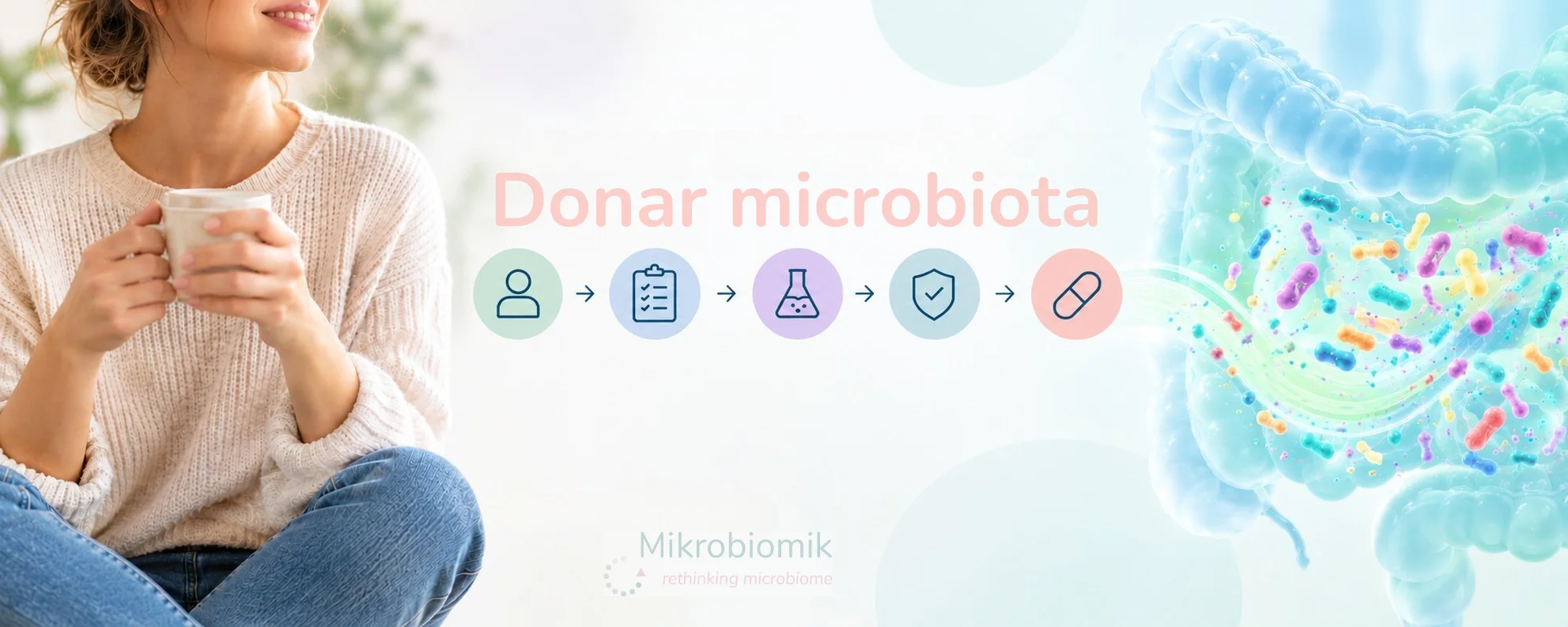
A donation does not pass directly from the donor to the patient. Instead, it follows a carefully designed process to ensure quality, safety and traceability:
Donation → screening and checks → processing → quality control → therapy
Before they can be accepted as donors, candidates go through a screening process that includes health questionnaires, medical interviews and laboratory tests. The aim is to assess their suitability as donors and protect both the donor and those who may subsequently receive a therapy made from their microbiota.
At Mikrobiomik, we develop EUTEGRA, a fecal microbiota-based therapy authorized in Spain under the European framework for Substances of Human Origin (SoHO).
Behind a therapy such as EUTEGRA lies complex scientific development, but it also depends on the support of people who have chosen to donate.
Without donors, there is no microbiota to transform
When we talk about healthcare innovation, we often think of laboratories, technology or new treatments. However, some innovations begin much earlier. They start with a healthy person who decides to donate.
Not everyone can become a microbiota donor. The screening process is rigorous because quality and safety must be ensured from the very beginning.
Being a donor is therefore about more than simply providing a sample. It means voluntarily taking part in a process in which health is assessed, checks are carried out and donations remain traceable. Technology makes it possible to process the microbiota, while quality controls help ensure its safety and quality.
Regulation that protects not only the donation, but also the donor
Europe has taken an important step with the new Regulation (EU) 2024/1938 on Substances of Human Origin (SoHO). One of its most notable aspects is the emphasis it places on donor protection. The Regulation establishes principles intended to ensure respect for donors, particularly their dignity and integrity, and to protect their health against potential risks associated with donation.
This translates into practical measures: providing clear and understandable information before consent is given; assessing the donor’s health; protecting their privacy, personal data and health information, including test results; and ensuring that the decision to donate is free and voluntary. Consent is therefore not merely a formality.
Being a donor means making an informed decision. Protecting donors means giving them the information and safeguards they need to make that decision.
Could you become a microbiota donor?
Being healthy is the starting point, but it is not the only requirement. Donor screening takes into account various factors relating to health, medical history, lifestyle and other potential risks. The process is then completed through an interview and the relevant laboratory tests.
This level of screening may seem demanding, but the reason is simple: safety starts with getting to know the donor’s health in detail and confirming their suitability to donate.
The easiest way to find out whether you can begin the process is to complete Mikrobiomik’s health questionnaire.
Are donors paid?
The European SoHO framework is based on a fundamental principle: donation must be voluntary and unpaid. This does not necessarily mean that donors must bear the costs, inconvenience or other burdens associated with donating.
The Regulation allows for compensation under certain conditions, while making an important distinction between compensating donors and financially incentivizing donation. The purpose of compensation is not to put a price on a substance of human origin or turn donation into a paid activity. Rather, within the established framework, it is intended to prevent donors from being financially disadvantaged because of donating.
This distinction matters because it preserves one of the fundamental principles of donation: the decision to donate must remain free and voluntary.
A journey built on trust
Every donation that meets the established requirements begins a controlled journey. The sample is identified and processed in accordance with the quality management system, undergoes checks and remains traceable throughout the process.
EUTEGRA, a fecal microbiota-based therapy, is developed using microbiota from selected healthy donors. Behind this lies a chain of screening, checks, processing, quality control and traceability designed to transform that contribution into material that can be used therapeutically.
That is why, when we talk about microbiota donation, we are talking about science and technology, but also about trust: donors contribute knowing that a system is in place to protect them and ensure their donations remain traceable.
Would you like to find out if you can become a donor?
The first step is to find out whether you may be eligible.
Complete Mikrobiomik’s health questionnaire to receive an initial assessment of your potential suitability as a donor: Cuestionario de salud