


Clostridium Difficile (CD) is the main pathogen responsible for antibiotic-associated diarrhea in developed countries and the most common cause of infectious diarrhea inside hospitals. Fidaxomicin is an approved antibiotic against Clostridium Difficile infections (CDI), while Fecal Microbiota Transplantation (FMT) has emerged as an effective and safe treatment for recurrent CDI. The aim was to assess the efficacy and safety of the experimental product MBK-01 compared to fidaxomicin in CDI cases, 8 weeks after the start of the treatment, evaluating the absence of recurrences.
RESULTS
ICD-01 clinical trial

Abstract
92 patients from 21 sites in Spain were randomly distributed.
-
- MBK-01 group: 45 patients
- Fidaxomicina group: 47 patients
*23 and 25 patients completing the study, respectively .
In the overall population,89.19% of the MBK-01-treated patients had no recurrence of CDI-associated diarrhea, while for fidaxomicin it was 77.50%.
MBK-01 proved non-inferiority than fidaxomicin in primary CDI cases and within patients with no previous antibiotic treatment (p<0.01), as MBK-01 was 100% effective versus 80% for fidaxomicin in this subgroup.
For recurrent CDI cases there was a significant difference in proportions of 0.4279 (p=0.014), thus demonstrating superiority of MBK-01 over fidaxomicin. Diarrhea was the only treatment-related Adverse Event for both groups, with MBK-01 showing less events than fidaxomicin (46,35% vs. 53,65%).
Topline results

- MBK-01 is considered non inferior to Fidaxomicin in efficacy and security in the CDI treatment.
- MBK-01 is considered non inferior to Fidaxomicin for the primary infection in the CDI treatment (1:1).
- MBK-01 is superior to fidaxomicin for the treatment of recurrent CDI (7:1)..
- The superiority of MBK-01 over fidaxomicin becomes more pronounced as the number of prior recurrences increases
- MBK-01 is 100% effective in the patients without an antibiotic pre-treatment.
- The treatment with MBK-01 is 100% safe (no SAEs).
Protocol
Official title
A Randomised, Controlled, Open-label Phase III Clinical Trial in Patients With Primary or Recurrent Clostridioides Difficile (CD)Infection, to Evaluate the Efficacy and Safety of MBK-01, Capsules of Lyophilised Faecal Microbiota vs Fidaxomicin.
Clinical Trials.gov ID NCT05201079
Follow up:
Participants should return for clinic visits at 72 hours, week 3 and week 8 after the start of the treatment, and receive follow-up phone calls at month 3 and month 6 after the start of the treatment. Stool samples collected from participants for further studies at time 0 and week 8 after the start of the treatment.
Inclusion Criteria
- Patients of both genders, over 18 years.
- Patients that undergo an episode of CD infection (either the first episode or subsequent recurrences).
- Presence of an episode of diarrhea defined as ≥3 stools/24 hours, at the beginning of the episode.
- Confirmation of the presence of CD toxin A and/or B in stool, by a direct toxin detection test or by the PCR technique for the detection of toxin/s producing genes, at the start of the episode that is going to be treated in the clinical trial (the toxin test must be positive within 7 days prior to the enrolment of the patient in the trial).
Exclusion Criteria
- Previous fecal microbiota transfer.
- Transplanted patients, except those with a solid organ transplant of more than 2 years, with good organ function.
- Absolute neutrophil count <500 cells /μL at the time of the enrollment in the study.
- Pregnancy, breastfeeding, or pregnancy intentions over the course of the study.
- Active treatment with bile acid sequestrants (for instance: cholestyramine).
- Positive patients for the human immunodeficiency virus (HIV) except those with lymphocytes T CD4 count > 200 cells/μL and viral load less than 20 copies.
- Swallowing dysfunction or no oral motor coordination.
- Patients admitted in an intensive care unit or expected to be admitted in an intensive care unit due to serious illness.
- History of significant medical conditions that, in the opinion of the investigator, would not allow an adequate evaluation or follow-up of the patient.
Sites

1
Madrid
2
Barcelona
3
Córdoba
4
Mallorca
5
Santander
6
Bilbao
7
Vitoria-Gasteiz
8
Donostia-San Sebastián
9
Zaragoza
10
Logroño
11
Valencia
12
Alicante
13
Girona
14
Sevilla
15
Málaga
16
León
1.MADRID
Hospital Ramón y Cajal
HU 12 de Octubre
HU Puerta de Hierro
HU Gregorio Marañón
HU La Paz
HU Quirón Salud Madrid
COMPASIVE USE
H Central de La Defensa Gómez Ulla
2. BARCELONA
HU de Bellvitge
Hospital Clínic
H Quirón Salud Barcelona
3. CÓRDOBA
HU Reina Sofía
4. MALLORCA
HU Son Espases
5. SANTANDER
HU Marqués de Valdecilla
6. BILBAO
HU de Cruces
HU de Basurto
COMPASIVE USE
H de Górliz (Bizkaia)
H de Urduliz (Bizkaia)
H San Juan de Dios (Bizkaia)
7. ARABA-ALAVA
HU de Araba
8. DONOSTIA-SAN SEBASTIÁN
HU de Donostia
9. ZARAGOZA
HU Lozano Blesa
COMPASIVE USE
HU Miguel Servet
10. LOGROÑO
Hospital San Pedro
11. VALENCIA
HU y Politécnico La Fe
12. ALICANTE
HU de Alicante
13. GIRONA
HU de Girona Doctor Josep Trueta
14. SEVILLA
COMPASIVE USE
HU Virgen del Rocío
15. MÁLAGA
COMPASIVE USE
HU de Málaga
16. LEÓN
COMPASIVE USE
HU de León
Clostridium Difficile – CDI
CDI arises when the colon becomes colonized by Clostridium Difficile, bacteria, resulting in an imbalance of gut microorganisms. that is dysbiosis. This imbalance is primarily triggered by antibiotic use. CDI leads to a range of symptoms, ranging from watery diarrhea to life-threatening colitis.
Clinical manifestation
- Antibiotic exposure:nearly every antibiotic has been associated with the development of CDI, including those used for treatment of CDI: Metronidazole and Vancomycin. High-risk CDI associated antibiotics are broad spectrum penicillin, cephalosporins, clindamycin, and fluoroquinolones.
- Age > 65 years: advancing age increases the risk of infection. Nonetheless a significant number of cases occur in a younger population.
- Hospitalization or nursing home stay: the incidence of Clostridium Difficile, colonization increases with the duration of the hospitalization. Recent studies suggest that the incidence of community-acquired CDI is growing.
- Protective barrier: normal intestinal microflora. When the balance of gut microorganisms is disrupted, Clostridium Difficile bacteria starts to dominate and colonize the large intestine which indicates the first step of infection.
Risk factors
- Colonization of the distal segment despite CDI can affect any part of the colon, the distal segment is the zone most commonly affected. Treatment should not be initiated solely based on a positive laboratory test for Clostridium Difficile, without any accompanying symptoms.
- Watery diarrhea: occurs in most cases during, or directly after, antimicrobial therapy, although CDI onset might be also a couple of weeks afterwards.
- Other clinical features: abdominal pain, fever, nausea, vomiting, weakness, and loss of appetite. Fecal blood test is often positive, although active bleeding is rarely present.
- Toxins: Clostridium Difficile produces two types of toxins, enterotoxin A and cytotoxin B. These toxins are transported to the cell cytoplasm disestablishing the cell cytoskeleton and causing inflammatory process and tissue damage.
Guidelines
Webinar, presentation of final results
In April we presented the results of the clinical trial, during a streaming where outstanding professionals who where part of the study submitted the results from their different perspectives
Presentation of the final results: Juan Barrero de la Rubia – Project Controller of SERMES CRO
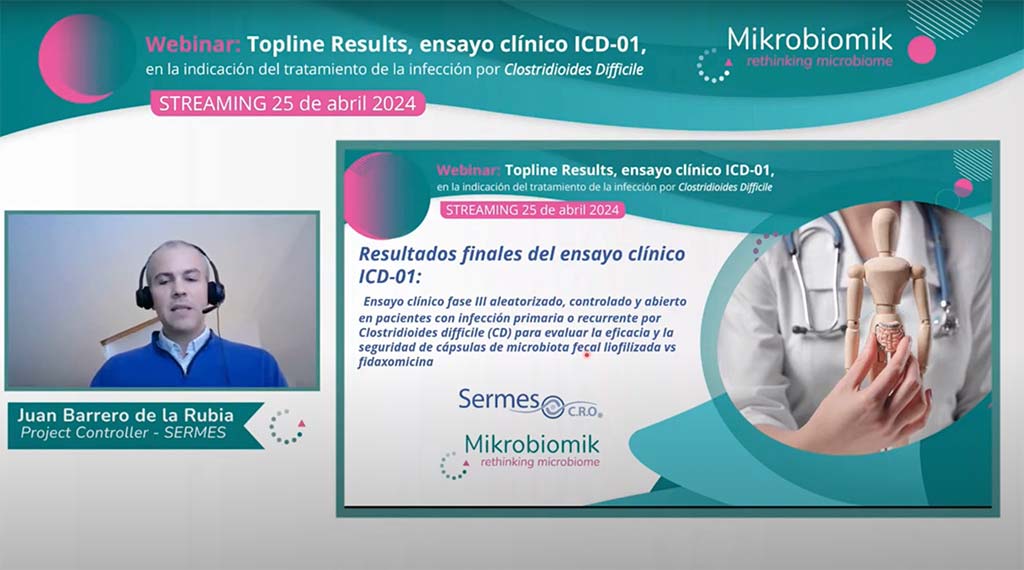
Discussion/Analysis of final results: Dr. Javier Cobo Reinoso, Trial Coordinator, Ramón y Cajal University Hospital.
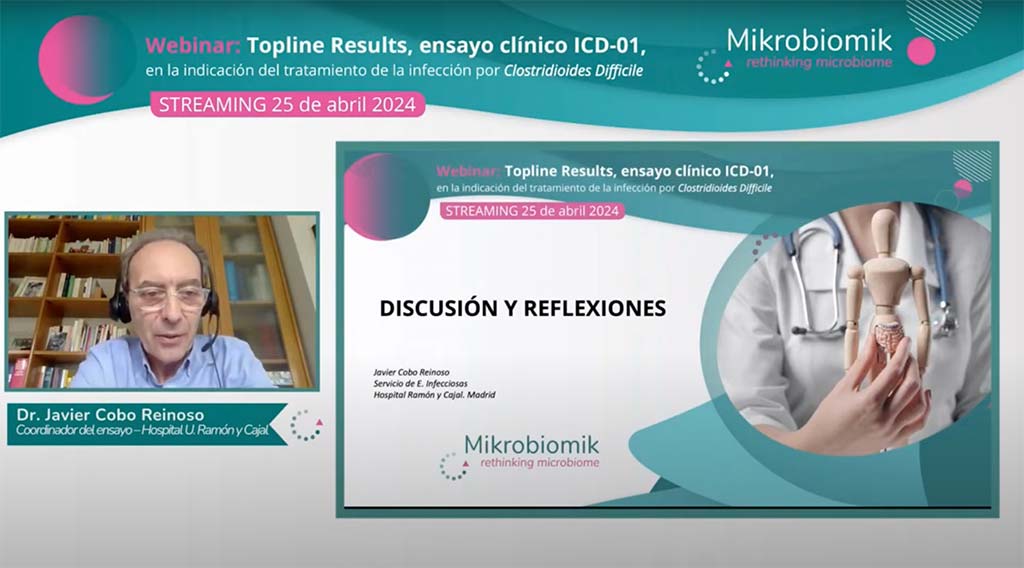
About compassionate use case – Dra. María Varela Cerdeira, Hospital Universitario La Paz.

